

Ingredients
Equipment
Quail eggs cook quickly. Half a minute can be enough to take the yolk from soft to firmer.
I find it easiest to use the size of the eggs as a starting point. In my own tests, small quail eggs need less time than large ones. This is especially useful if your eggs vary greatly in size.
Why do quail eggs vary in size?
Quail egg size varies between species and genetic lines. The age of the hen also matters.
Japanese quail eggs generally become larger as the hen gets older. Several studies have shown this. Genetics also has a major influence on egg size.
There are also large differences between quail species. Blue-breasted quail eggs are considerably smaller than Japanese quail eggs. A recent study of blue-breasted quail reported an average egg weight of 5.63 grams. Studies of Japanese quail often report averages around 11–13 grams, depending on age and line.
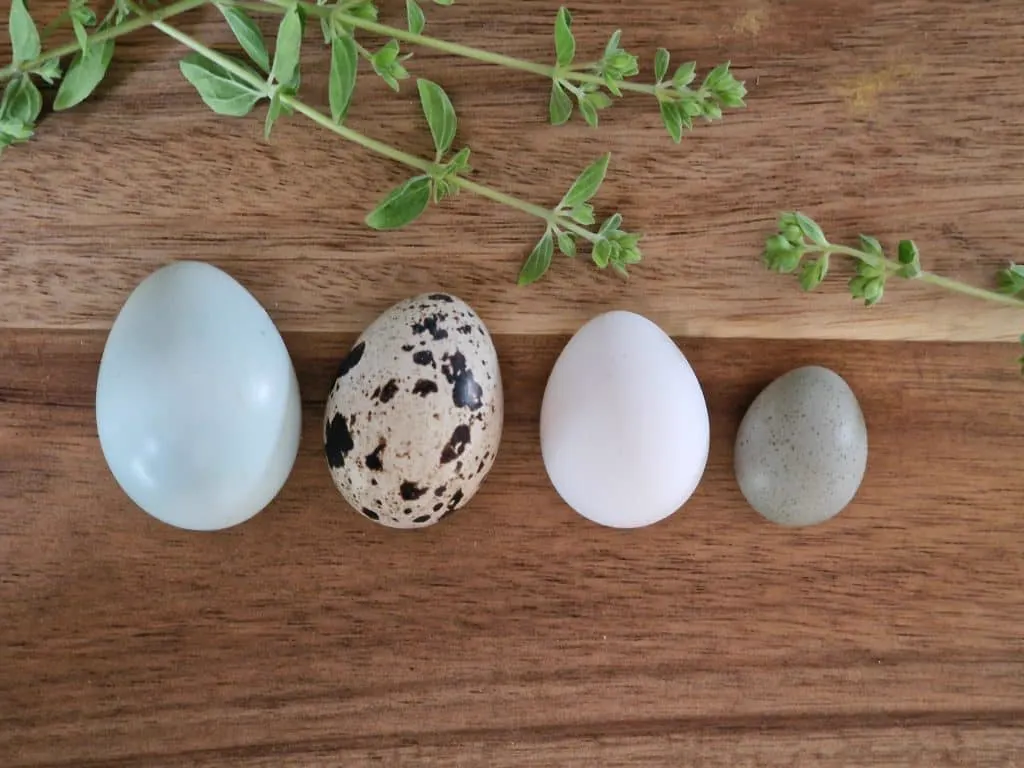
The first eggs may look a little unusual
When young hens begin laying, I often see greater variation in egg size. Some lay very small eggs. Others may lay unusually large, double-yolk eggs.
With my quail, this usually evens out over time. It almost seems as though they need to “calibrate” before their eggs become more normal and even in size.
Double yolks are documented in Japanese quail. Research has found that some genetic lines produced more double-yolk eggs than others. However, I have not found good research showing that double yolks are especially common at the very start of laying in Japanese quail. That part is therefore my own observation.
Do jumbo quail lay larger eggs?
Large jumbo lines of Japanese quail can lay larger eggs. But a large quail does not necessarily lay a correspondingly large egg.
Studies of Japanese quail show that selection for greater body weight can also produce larger eggs, but the increase in egg size does not directly follow the increase in body weight. There can therefore be considerable variation between genetic lines and individual quail.
Quail egg cooking times
I tested these cooking times with my own quail eggs in different sizes. The table below shows my results and can be used as a starting point when the eggs are placed directly into boiling water.
| Egg weight | Soft-boiled | Medium | Hard-boiled |
|---|---|---|---|
| 10 g | 2 min | 2.5 min | 3 min |
| 15 g | 2.5 min | 3 min | 3.5 min |
| 20 g, very large egg | 3 min | 3.5 min | 4 min |
A 20-gram quail egg is large compared with the egg weights usually reported for Japanese quail in research. In one study of quail at different ages, the average weights were 11.66 grams in the youngest group, 12.11 grams in the middle group and 13.16 grams in the oldest.
The times in the table are my own test results. They may vary slightly with the temperature of the eggs, the amount of water, how many eggs you cook at once and how quickly the water returns to the boil.
Try a couple of eggs first if you are cooking many, especially if you want the yolk to be exactly the right softness.
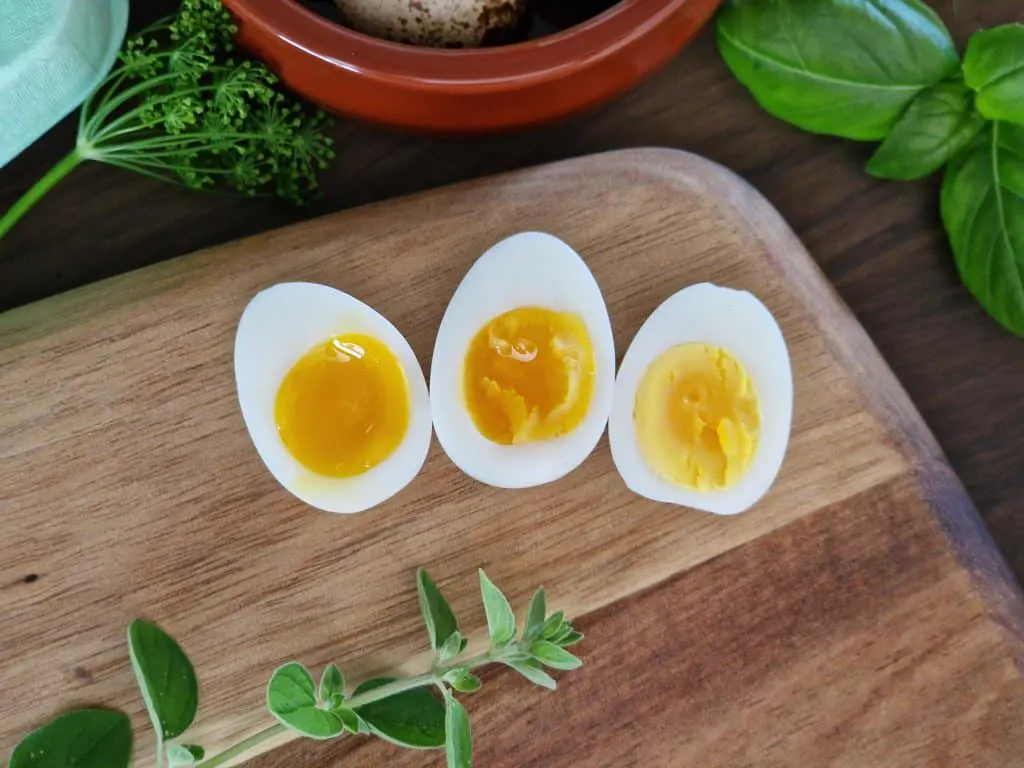
The eggs in my photo weighed 15 grams. They were cooked for 2.5 minutes, 3 minutes and 3.5 minutes. I then placed them straight into ice-cold water and left them for at least five minutes before peeling.
Instructions
Bring the water to the boil
Fill a small saucepan with enough water to cover the quail eggs. Bring the water to the boil.
Lower the eggs into the water
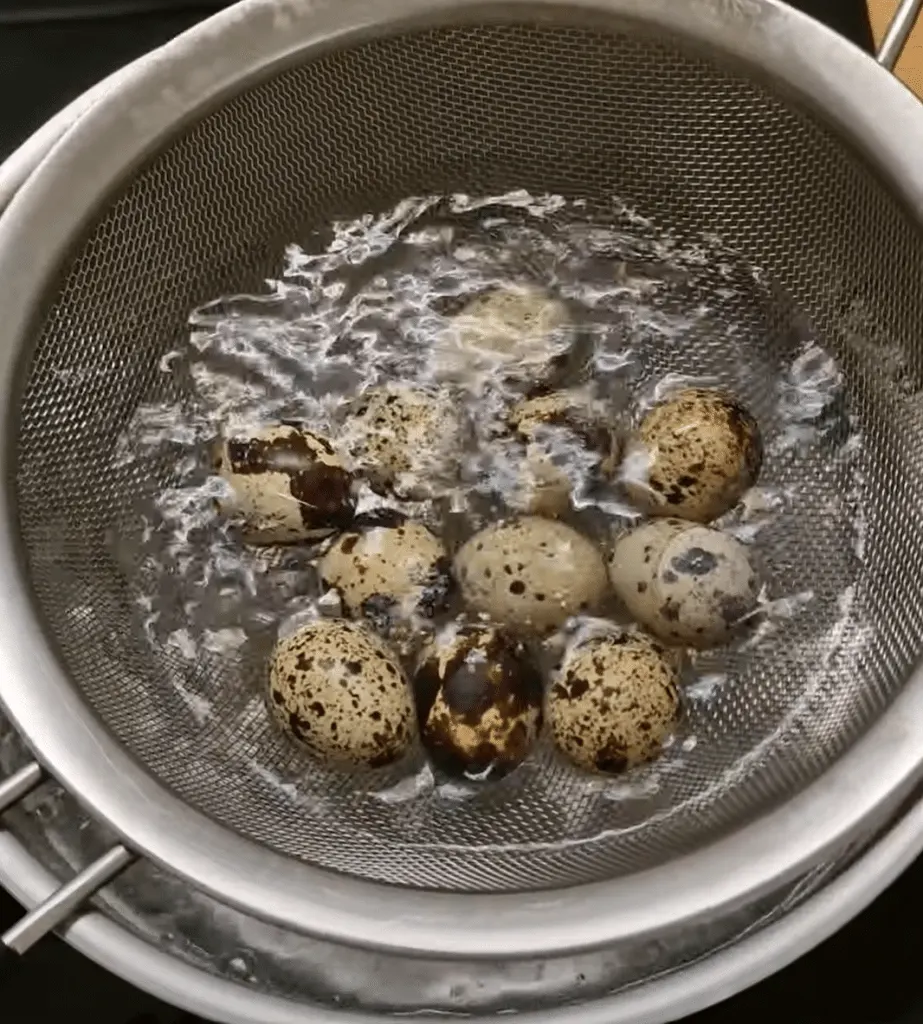
When the water boils, carefully lower the eggs into the saucepan. I use a slotted spoon or a small strainer. This gets all the eggs into the water at about the same time and prevents them from being dropped against the bottom.
Start the timer
Start timing as soon as the eggs enter the water.
Cook according to size
Cook them according to the table above, depending on their size and how you want the yolk.
Cool the eggs quickly
When the time is up, transfer the eggs straight into ice-cold water. Leave them there for at least five minutes. This cools the eggs quickly and limits further cooking.
Peel the eggs
You can then peel them. Gently crack the shell all around the egg and roll it lightly between your fingers. I find it easiest to start at the blunt end, where the air cell is.

Tips
- Quail eggs are small, so lower them gently into the water. The shells may crack if the eggs are dropped against the bottom of the saucepan.
- Slightly older eggs may be easier to peel than completely fresh eggs. A study comparing hard-boiled eggs from chickens, ducks, turkeys and quail found that peeling properties changed during storage.
- Rapid cooling may also help. In another experiment involving quail eggs, brief cooling in ice water after boiling improved peeling.
- If the eggs will be used in a salad, tapas or as decoration on a platter, I usually cook a few extra. It is easy to damage the white when peeling such small eggs.
FAQ about boiling quail eggs
How long should quail eggs boil?
It depends on their size and how you want the yolk.
In my own tests, placing the eggs directly into boiling water, I use 2 minutes for a soft-boiled egg weighing around 10 grams and 2.5 minutes for an egg weighing around 15 grams.
For a 15-gram egg, 3 minutes gives a firmer but still soft yolk. Around 3.5 minutes gives a hard-boiled result.
Use the table above as a starting point. Egg temperature, size and how quickly the water returns to the boil can affect the result.
Should quail eggs go into cold or boiling water?
I place them in water that is already boiling.
That way I know exactly when cooking begins, and I find it easier to achieve the same result each time. The cooking times in the table on this page were tested with this method.
If you start with the eggs in cold water, you need to calculate the cooking time differently.
Why are quail eggs difficult to peel?
Very fresh quail eggs can be more difficult to peel than eggs that have been stored for a while. This has also been shown in tests with hard-boiled quail eggs.
I put the eggs straight into ice-cold water after cooking. Then I gently crack the shell all around the egg before I begin peeling.
Tests with several kinds of eggs, including quail eggs, have also shown that chilling in ice water can improve peeling.
Do quail eggs need to be washed before boiling?
Clean eggs do not need to be washed.
Animalia states that naturally clean eggs do not need washing. If eggs are washed incorrectly, water and bacteria can pass through the shell. They also recommend that cracked and very dirty eggs should not be washed for use as ordinary table eggs. The Norwegian Food Safety Authority gives a similar warning about incorrectly performed egg washing.
If I have a clean egg, I therefore do not wash it before boiling.
Can quail eggs be eaten soft-boiled?
A soft-boiled quail egg is not fully heat-treated. It is therefore important to know where the eggs come from.
The Norwegian Food Safety Authority states that packaged Norwegian eggs covered by the salmonella guarantee can be eaten raw. This advice should not automatically be transferred to quail eggs from a hobby flock.
In the regulation for Norway's salmonella control programme, “poultry” is defined as chickens, turkeys, guinea fowl, ducks and geese. Quail are not included in this definition. Hobby flocks whose products are used only in the owner's household are also explicitly exempt.
I would therefore not describe Norwegian quail eggs as “salmonella guaranteed” without documentation from the relevant producer or flock.
If you want to reduce the risk as much as possible, the egg should be heated until both the white and yolk are firm.
Does a floating quail egg mean it is bad?
No.
As an egg ages, some water evaporates through the shell and the air cell becomes larger. Eventually, the egg may become light enough in relation to its volume to float.
A floating egg is therefore often older, but the float test cannot tell you whether the egg contains disease-causing bacteria.
The USDA describes a floating egg as one with a large air cell and lower quality, while noting that it may still be safe to use. Smell and appearance must be assessed when the egg is opened.
The float test is therefore a poor food-safety test.
Can boiled quail eggs be prepared in advance?
Yes. Cool them after cooking and keep them refrigerated.
I have not found specific Norwegian shelf-life advice for boiled quail eggs. The USDA states up to one week in the refrigerator for hard-boiled eggs in general. That advice was not written specifically for quail eggs.
If I am using quail eggs in a salad or serving them neatly on a platter, I still prefer to boil them relatively close to serving.